


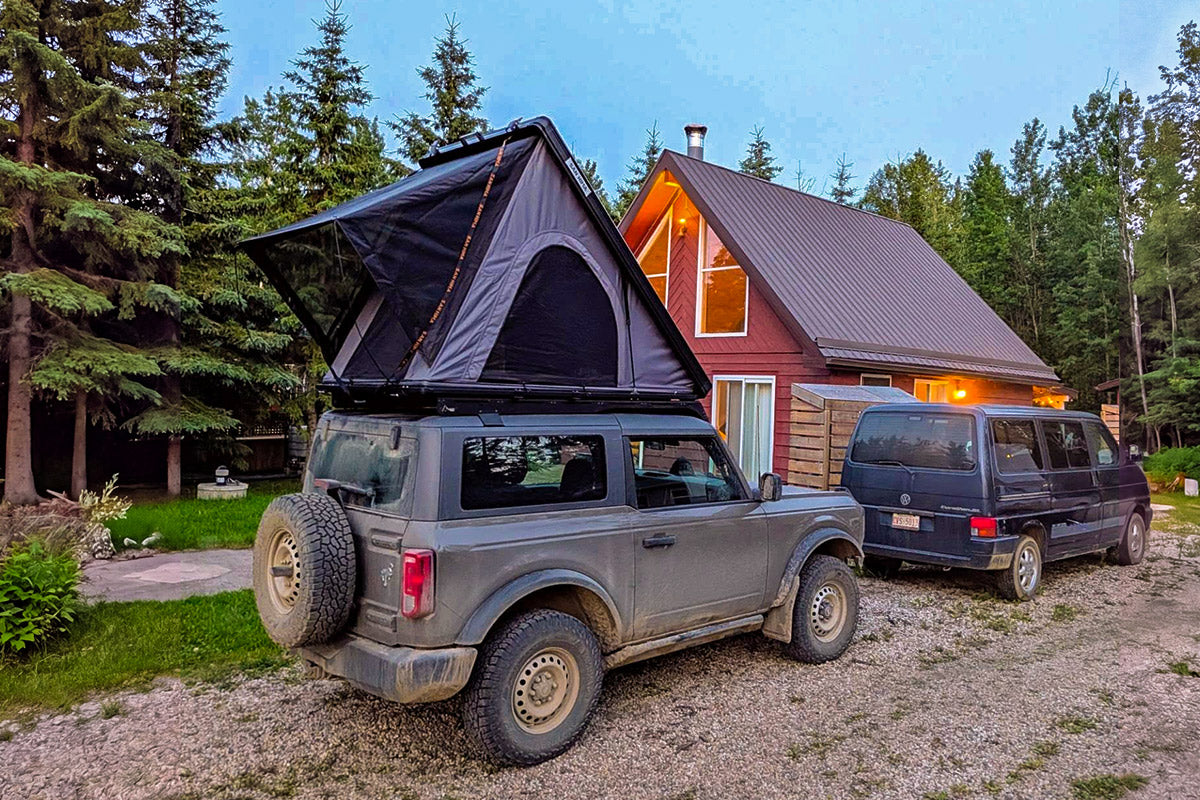
Four days, one two-door Bronco and the kind of storm that tells you whether a camp setup has earned its place.
Story inspired by @snektredmoantain · Seventh annual end-of-summer adventure · September 2026
After a year away, @snektredmoantain returned to the Rockies for the seventh annual end-of-summer run and the Bronco’s first proper shakedown. The trip tested every part of the build, from its locker and underbody protection to the SAN HIMA Kalbarri / Hotham Lite rooftop tent in a serious storm. It also left one clear item on the upgrade list: better tyres before the next, bigger adventure.

The riverbed was pale with stone, the trees were already holding onto the last green of the season, and a grey two-door Bronco sat at the water’s edge with a low black tent folded over the roof. It was the sort of place where a vehicle stops looking like a collection of upgrades and starts becoming a travelling companion. For @snektredmoantain, it also marked a return: the seventh annual end-of-summer adventure, back after missing the previous year.
DAY ONE
This was the Bronco’s first time on the trip. The route would stretch over four days, beginning with a friend in the passenger seat after his Nissan Frontier developed problems before departure. That change of plan made the first two days a shared test drive, with every rough section quietly answering the same question: had the Bronco been built for the way it would actually be used?
The annual trip returns
Annual trips carry their own rhythm. There is the familiar packing, the first turn away from the highway and the small satisfaction of recognising a track that has changed just enough to feel new again. This one was more than a reunion with the mountains. It was the first chance to live with the Bronco’s setup for days rather than judge it from a driveway or a short afternoon run.

The photographs from the first day show how quickly the character of the route changed. One moment the Bronco was small against an open riverbed; the next it was threading between close-set spruce on a track barely wider than the tyres. There was no single obstacle to define the day. The challenge came from the accumulation of loose stone, shallow water, tight trees and changing weather, each asking something slightly different from the vehicle and its driver.
That variety is what makes a familiar annual route valuable. A new part can feel convincing on one climb and irritating after three hours of vibration. A storage decision that seems tidy at home can become awkward after the fifth stop. With two people sharing the cabin for the opening days, the Bronco also had to work as a small living space, not simply as a capable machine pointed at the next section of trail.
The forest track put the build to work early. Rear shock skids took hits while protecting the coilovers, rock sliders kept the body clear more than once, and the winch remained unused but reassuringly close. The Ford Performance electronic-locking rear axle was less optional than expected. Being able to engage it when traction disappeared helped the Bronco move through sections that would otherwise have demanded more wheelspin or a different line.
Then the trip found the limit. The 265/75R16 all-terrain tyres were already a sensible step up from the factory rubber, but with the suspension lifted and the rear axle locked, they became the weakest part of the package. That was useful knowledge, not a disappointment. A proper shakedown is meant to expose the next decision, and this one ended with a promise of new shoes by spring.
A place to sleep, chosen before the miles
The sleeping setup had been part of the Bronco plan from the beginning. At 6 feet 3 inches tall, the owner had little interest in folding himself into the back of a two-door vehicle. Ground camping held even less appeal in grizzly country. The brief was therefore simple and personal: a hard shell, a low profile, manageable weight and a price that left room for the rest of the build.

After plenty of research and conversations with other campers, the SAN HIMA Kalbarri / Hotham Lite rooftop tent kept coming back into view. It fitted the brief, arrived well packaged and mounted neatly to the low-profile TrailRax roof rack. In the owner’s early setup experience, the clamshell opened or closed in under a minute, a welcome contrast to wrestling a soft tent into its cover on a wet mountain morning.
A good camp setup does not need to dominate the day. It simply needs to be ready when the driving stops.
That speed mattered because the tent was not being chosen for a showroom photograph. It needed to disappear into the roofline while travelling, then become a reliable place to sleep when light faded or weather closed in. Roof load, mounting security and the combined height of the vehicle and tent still need to be checked for any installation, but on this Bronco the selected rack-and-tent pairing stayed where it belonged and remained quiet on the move.

When the weather arrived
The mountains eventually supplied the kind of test no driveway can reproduce. A serious storm moved through camp. By morning, the report on the SAN HIMA Kalbarri / Hotham Lite rooftop tent was reassuring: it had given its owner a comfortable night, its practical details made sense in use, and it had weathered the conditions without coming loose or adding rattles above the cabin. It is one trip, not a laboratory test, but it is exactly the kind of firsthand evidence that makes a piece of gear feel less theoretical.

The rest of the trip was measured in more ordinary signs of success: boots beside the vehicle, a fire catching in the rocky riverbed, gear left alone because nothing needed fixing. The Bronco returned with its skid plates marked, its sliders justified and its winch line untouched. The roof tent had become part of that same story, not as a dramatic centrepiece, but as the place the day ended and the next one began.
There is already a larger adventure taking shape for next year. Before then, the tyres will change and the Bronco will keep evolving. That is the honest pleasure of a trip like this: it does not pronounce a build finished. It shows what works, points directly at what does not, and sends the vehicle home with a shorter, smarter list for the road ahead.


Leave a comment
This site is protected by hCaptcha and the hCaptcha Privacy Policy and Terms of Service apply.